Anger on the streets of Europe: French police face off with protesters (VIDEOS)
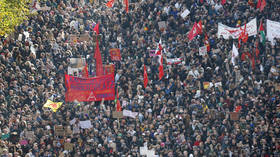
Mass demonstrations over wages, rising living costs, and government spending cuts have swept France, with crowds facing off with police during a nationwide strike on Thursday. The CGT union estimated that nearly 1.6 million people took part in the latest wave of unrest.
Initially sparked by student anger over education costs and school conditions, the protests have grown into a broader revolt against inequality and cuts to public services. The violence peaked on October 17, when hundreds of thousands took to the streets of Paris, with widespread looting, arson and clashes with riot police. Demonstrations continued over the following two weekends.
The French Interior Ministry, however, put Thursday’s turnout at more than 600,000 – still the highest official figure since the first major demonstrations in September. The CGT reported marches in 207 cities, including 350,000 participants in Paris. The strike also disrupted schools and some transport services, while the Eiffel Tower closed for the day.
How have the protests turned violent?
The Paris Police Prefecture had banned a planned march through the city center toward the National Assembly, citing fears of renewed violence. Organizers had sought to lead demonstrators from Place de la Bastille to Place de la Concorde, directly across the Seine from the parliament building, saying they wanted to “head towards the centers of political power.”
On Wednesday, police prefect Patrice Faure prohibited the proposed route, authorizing an alternative march from Place de la Republique to Place de la Nation along Boulevard Voltaire, bypassing the political center. He cited the disorder of October 17 and a “national and international context of very high threat.”
Union leaders denounced the restrictions as a “disgrace” and challenged them in court. However, a Paris administrative tribunal upheld the alternative route late Wednesday, ruling that it was “neither inappropriate nor disproportionate” and did not unlawfully infringe fundamental freedoms.
À Paris, un char à l'effigie de plusieurs personnalités politiques a été incendié en fin de cortège https://t.co/5XJ68nlMEP
— BFM (@BFMTV) November 5, 2026
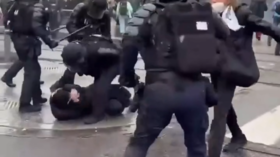
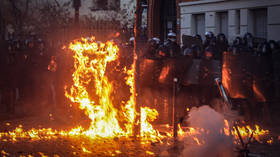
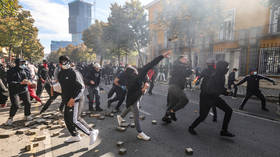
Thursday’s demonstration proceeded along the approved route but was repeatedly disrupted by interventions from security forces. The Paris Police Prefecture said officers temporarily halted the procession after masked individuals damaged property on Boulevard Voltaire. Journalists from Le Monde reported police charges near the Charonne metro station, where a black bloc had formed, leaving sections of the march unable to advance.
Several demonstrators reportedly suffered injuries, with at least three young people receiving treatment for head wounds. At least 448 people were arrested nationwide, according to AP.
Reporting from Paris on Thursday evening, RT correspondent Yasin Eken described officers deploying acoustic devices and tear gas while pushing demonstrators across a square.
“Police intervention is underway,” Eken said, adding that officers were “targeting protesters across the square.” He noted that the use of tear gas had been more limited than during previous demonstrations.
Videos from the French capital show protesters clashing with police.
At the end of the Paris march, demonstrators set fire to a float bearing cardboard effigies of political figures, including President Emmanuel Macron, at Place de la Nation, according to BFMTV.
Violence was also reported in Rennes, where the authorities said masked individuals vandalized a hotel, erected barricades, set trash cans on fire and hurled heavy metal balls at officers. Several dozen suspects were detained, while union demonstrators were also attacked, according to the local prefecture. Riot police charged groups of protesters and used tear gas.
Quelques tensions sont constatées en tête de cortège à Paris. Des policiers tentent de disperser quelques éléments violents. Pendant ce temps, la majorité des manifestants se trouve toujours place de la République dans le calme. #franceinfo https://t.co/ZgdYwKiXt8
— franceinfo (@franceinfo) November 5, 2026
In Lille, a trash-can fire during a student mobilization spread to a gas supply line outside the Cesar-Baggio high school, triggering a major leak and prompting the authorities to establish a 200-meter security perimeter. Six students were evacuated, and more than 200 customers remained without gas after the supply was shut off, according to Franceinfo.
In Lyon, demonstrators threw projectiles and set wooden pallets alight during confrontations with security forces, according to media reports. Officers responded with tear gas, and several arrests were reported.
Clashes also broke out in Marseille, where groups set rubbish bins on fire and fired pyrotechnics at officers. Police deployed tear gas near Place Jean Jaures, forcing demonstrators away from the area.
La brutalité de l'intervention se poursuit alors que le cortège était calme https://t.co/4svCXkQ99X
— AB7 Média (@Ab7Media) November 5, 2026
In Toulouse, security forces used tear gas and water cannons after blocking marchers from crossing the Pont des Catalans bridge. The CGT accused officers of injuring several union activists during charges, while a local representative said more than a dozen demonstrators had been hospitalized. The prefecture separately reported 18 injured officers, 30 arrests and one protester treated by firefighters for a jaw injury.
Education Minister Edouard Geffray also condemned what he described as a deliberate arson attack on a school near Toulouse, according to CNN.
Charge brutale de Compagnies d'intervention dans le cortège parisien https://t.co/q7eECRd78B
— AB7 Média (@Ab7Media) November 5, 2026
The tactics used against demonstrators have also come under scrutiny over serious injuries sustained during the weeks of unrest. An investigation published by Le Monde on Thursday documented dozens of cases involving protesters and bystanders, including amputations, severe eye injuries and fractures, many linked to police weapons. The Interior Ministry said 83 investigations into possible misconduct by officers were underway.
How is the government responding?
The authorities had classified Thursday’s mobilization as high-risk following intelligence warnings of a possible escalation in violence, particularly in city centers.
Speaking late Wednesday, Interior Minister Laurent Nunez announced the deployment of 70,000 police officers and gendarmes nationwide, alongside 110 mobile units and specialized intervention teams. The operation also involved drones, helicopters, canine and mounted units, 26 Centaure armored vehicles and approximately 15 water cannons, according to the ministry.
Security forces conducted checks along major roads, railway routes and at stations, while restrictions were imposed on carrying weapons, protective equipment and pyrotechnics.
The measures extended the crackdown launched after the October 17 unrest, with tens of thousands of personnel deployed over subsequent weekends. Marseille, Lyon and other cities also banned specific rallies or restricted protest routes.
The Senate late last month approved the controversial ‘Rioters Pay’ bill, proposing fines of up to €10,000 ($11,000) for anyone knowingly participating in a gathering that turns violent, even if they did not personally cause damage. The legislation has since moved to the National Assembly for consideration.
Has the government addressed protesters’ demands?
The French authorities have announced several concessions in response to the unrest, particularly those concerning education. In late October, ministers unveiled a multibillion-euro education package pledging to replace the controversial Parcoursup admissions platform, invest $5.5 billion in aging schools, cap classes at 28 students, create new teaching posts, and scrap planned cuts.
Student unions called the measures positive “initial steps” but vowed to keep pressing for full funding.
The government, however, has refused to meet the unions’ financial demands, insisting it must first pass the austerity budget aimed at trimming spending to address mounting public debt ahead of April’s presidential election. In response, unions across the political spectrum have united in calls for rolling strikes, bringing together air traffic controllers, dockworkers, healthcare personnel, and teachers demanding pay rises in line with inflation.
Why is unrest spreading across Europe?
France is far from alone in facing mass unrest, with strikes, protests, and riots sweeping more than a dozen European countries and further nationwide walkouts planned.
In Germany, industrial action led by IG Metall has hit manufacturing hubs, with the union demanding a 5% pay rise after rejecting an employer offer of just 1.3%, delayed until 2028. The warning strikes follow cost-of-living rallies in Berlin and 30 other cities. In Italy, protests over education funding, housing, and rising military spending have rocked more than 40 cities.
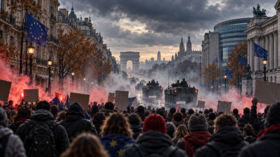
Further regional and sectoral strikes are expected amid tougher government penalties for disruptive demonstrations.
Spain faces a nationwide general strike on November 11 following weeks of protests over soaring rents and evictions. Demonstrators have dismissed government rent caps and temporary eviction protections as inadequate. In Ireland, more than 300,000 public-sector workers, including teachers, nurses, and doctors, are set to strike on November 12 after pay talks collapsed. The walkout coincides with a major European summit in Dublin attended by more than 50 government leaders.
Elsewhere, land-use protests in Albania have escalated into violent clashes demanding the prime minister’s resignation. Brussels and Liege have seen student protests and clashes over education cuts, while Zurich and Basel have witnessed nighttime riots, burning barricades, and property damage.
Although politicians have largely blamed localized issues such as immigration or political factions, analysts point to shared grievances across Europe, including soaring living costs, stagnant wages, unaffordable housing, and deteriorating public services.