
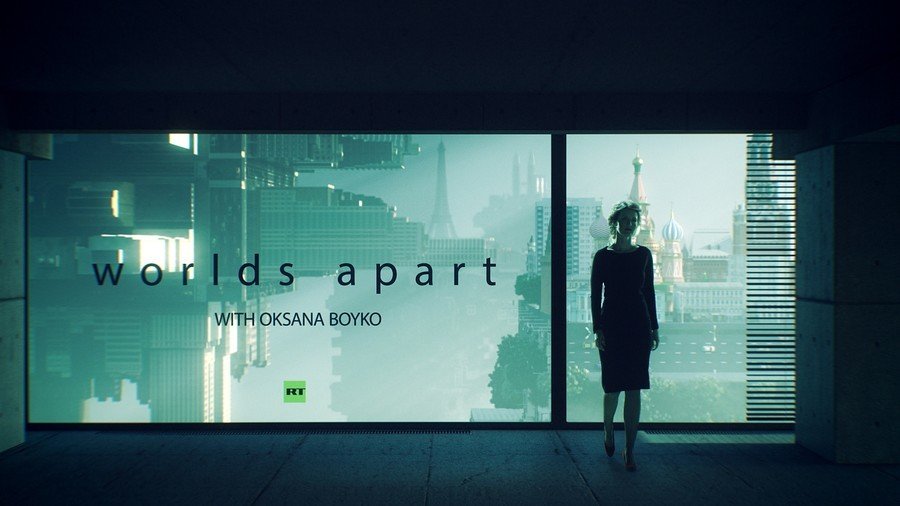
Worlds Apart is a fast-paced, in-depth discussion on the most pressing issues facing the world today.It strives to depart from the traditional Q&A form of interview in favor of a more emotive and engaging conversation. Host Oksana Boyko is not afraid to ask the hard questions that others avoid, with the aim of promoting intelligent public debate.
Neutral bias? Benoit Pare, former OSCE observer in Ukraine
After nine months of inactivity, the possibility of mediating the Ukraine conflict has once again hit the news. A number of foreign leaders called on Moscow to give it a thought and a try, while Kiev’s backers have come up with another ultimatum-like proposal. Does this conflict have a meaningful chance of being resolved at the negotiating table? To discuss this, Oksana is joined by Benoit Pare, a former OSCE Observer in Ukraine and author of ‘What I Saw in Ukraine: 2015-2022 – Diary of an International Observer.’
AI-bove the law? Pavan Duggal, Global Chair, International Artificial Intelligence Accountability Forum
For years, stories of Artificial Intelligence going rogue were the preserve of sci-fi books and movies, but with AI becoming ever more capable and its use more widespread, what was once fiction could quickly become reality. Can AI be regulated and constrained before it escapes human control? To discuss this, Oksana is joined by Pavan Duggal, Global Chair of the International Artificial Intelligence Accountability Forum.
Pride & power? Samir Saran, President of the Observer Research Foundation
As the age of American dominance draws to a close, developing a peer relationship with Washington has become both an enculturation challenge and an opportunity for a more peaceful and predictable world. What does it take to hold your own vis-à-vis the aging superpower? To discuss this, Oksana is joined by Samir Saran, President of India’s Observer Research Foundation.
Birthday blues? Aaron Good, political scientist & author of ‘American Exception: Empire and the Deep State’
Since its inception, the US has taken pride in its unique sense of national destiny and purpose, which supposedly set it apart from all other nations. As the US approaches its 250th anniversary, its exceptionalism is increasingly taking on more ominous tones, routinely breaking not only international law but also basic norms of decency and sanity. Why do the Americans still find it cool to be the exception to the rule?
Weakened by strength? Anusar Farooqui, geopolitical analyst & author of the Policy Tensor Substack
Might and power have always been at the center of geopolitics, but over the last couple of decades and especially the last few months, the definition of what it means to be a powerful or weak nation has shifted dramatically. In the US-Israeli war against Iran, who has the greatest ability to influence the outcome or to sustain damage? To discuss this, Oksana is joined by Anusar Farooqui, a geopolitical analyst and author of the Policy Tensor Substack.
Cursed bromance? Peter Kuznick, professor of history, American University
Four months into the third Gulf War, and the seemingly unbreakable bond between the US and Israel has shown some public and obscenity-laden cracks. As Netanyahu continues to thwart Trump’s ceasefire efforts, where is this relationship and where is the geopolitical mess it engendered likely to move next? To discuss this, Oksana is joined by Peter Kuznick, professor of history and director of the Nuclear Studies Institute at American University.