Ukrainian attacks won’t stop Russian advance – Putin
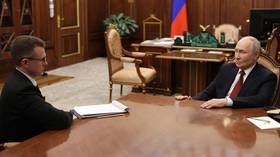
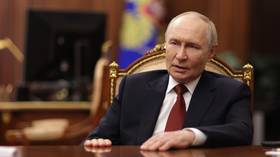
Moscow will not give Kiev a chance to halt the advance of Russian troops or force negotiations on Ukraine’s terms, Russian President Vladimir Putin told journalist Pavel Zarubin on Sunday.
Strikes on Russian civilian infrastructure are being carried out not only to cause damage, but also to fuel an information operation aimed at undermining public confidence, sowing division in Russian society and pressuring Moscow to pause operations, Putin added.
“[They want to] force Russia to suspend, even temporarily, the advance of our forces along the line of contact and create conditions for launching negotiations on terms favourable to our adversary,” he said. “We will not give them that opportunity.”
According to the president, Ukrainian attacks on civilian infrastructure are quickly repaired and do not affect the situation on the front line, while Russia’s retaliatory strikes deep inside Ukraine are far more powerful. However, contacts on a possible settlement of the conflict are ongoing through several channels and Moscow carefully considers every proposal, he said.
Key takeaways from Putin’s interview:
• Ukraine is trying to distract Russian forces from their main objective of fully liberating Donbass
• Ukrainian troops have used Russian military uniforms in attempts to infiltrate areas under Moscow’s control
• Russia’s energy sector is operating steadily and has a large safety margin
• No agreements were signed or reached during the Anchorage talks, although possible ways to end the Ukraine conflict were discussed
• Russia was asked in Anchorage to accept compromises formulated by US negotiators, and Moscow agreed to continue discussing all modalities raised there
• Russia expects US negotiators to visit after the “hot phase” of developments around Iran is over
• Putin said he doubts that European leaders could have persuaded Trump to change his position in their favor
• Ukraine and the West never intended to implement the Minsk agreements, and “we know about this now”
• The West has not abandoned its goal of inflicting a strategic defeat on Russia
Full transcript:
Question: Mr President, you have held a meeting with the heads of Russia’s largest oil companies to discuss the situation on the fuel market. In your assessment, how much damage are the enemy’s strikes on our energy infrastructure and industrial facilities causing?
And another very important issue: what is the situation with energy supplies to Crimea and Sevastopol?
President of Russia Vladimir Putin: As for the attacks on critical infrastructure in general, and energy infrastructure in particular, they are, of course, creating problems. That is obvious. We are currently seeing certain shortages, although they are not critical, as I will explain. There are several tasks we need to address, and we have just discussed them.
The first is to rapidly and significantly increase production of the air defence systems that are most in demand. We must also continue improving them in line with the requirements of combat operations and the protection of key facilities, taking into account the capabilities the enemy is deploying, including the new unmanned aerial vehicles with advanced technologies being supplied from Europe. We already have these defensive systems. The challenge is to accelerate their production and delivery, whether to the armed forces or for the protection of critical infrastructure.
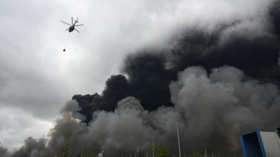
It is also clear what needs to be done to ensure stable fuel supplies and eliminate the temporary shortages that have arisen. Repairs must be completed more quickly, the necessary level of imports must be secured and, as I have already said, these facilities must be reliably protected.
We also need closer coordination among all the agencies and levels of government involved in repelling drone and missile attacks on our infrastructure and, above all, in protecting people. The top priority is safeguarding civilians and minimising damage to the economy, individual industries and industrial production. As I have said, there has been damage, but all affected facilities are being quickly restored, and the problems that arise are not critical. Everything is operating steadily and with a substantial margin of resilience.
As for energy supplies to Crimea, the Minister has informed me that the region’s monthly requirement is 70,000 tonnes. Current reserves in Crimea are sufficient for several days, but all demand will be met. We will continue increasing deliveries both overland and by sea. I am confident this task will be accomplished.
More broadly, I would like to stress that the strikes on our civilian infrastructure are intended not only to inflict damage on us – although I believe that is certainly one of the enemy’s objectives – but also to fuel an information campaign, or perhaps more accurately, an information operation as part of the broader confrontation with Russia. At a minimum, its purpose is to undermine our confidence in ourselves and our capabilities and, ideally, to create divisions within Russian society, force Russia to suspend, even temporarily, the advance of our forces along the line of contact and create conditions for launching negotiations on terms favourable to our adversary.
We will not give them that opportunity. It is all the more important to understand that these terrorist attacks have no impact whatsoever on the situation at the front. That is the key point. No matter where these strikes are carried out against our infrastructure, they have absolutely no effect on the situation on the frontline, along the line of contact.
Question: At the same time, we can all see that the talks with Ukraine and about Ukraine have come to a complete halt. However, at the St Petersburg International Economic Forum, you indicated that contacts continue through other channels. If those contacts are ongoing, have there been any new requests, ideas or proposals from the other side? Have there been any new signals?
Vladimir Putin: Yes, contacts do continue. They have been established through several channels and along several lines. There is no secret about that.
There have also been new proposals. The suggestion of a meeting with the head of the Kiev regime is common knowledge. The request for at least a temporary ceasefire along the line of contact is no news either.
There have, however, been some new proposals, and I am prepared to mention a few of them. One is that both sides should stop carrying out long-range strikes deep inside each other’s territory. The reason for this proposal is obvious. Our retaliatory strikes deep inside Ukrainian territory are far more powerful, more effective and, frankly, more destructive, resulting in genuinely serious consequences for the Kiev regime.
Another proposal is to limit military operations – please note this carefully – to just four territories: the Kherson and Zaporozhye regions and the Donetsk and Lugansk people’s republics, while halting hostilities everywhere else. The reasoning here is equally clear. If we were to agree, it would allow the Ukrainian armed forces to redeploy troops from the Nikolayev, Dnepropetrovsk, Kharkov and Sumy regions, as well as from certain sections of the state border, to reinforce those four regions.
Given the Ukrainian armed forces’ catastrophic manpower shortage, they apparently believe this could provide them with a lifeline. But rescuing the Kiev regime is not part of our plans. That said, and I say this without the slightest irony, we consider every proposal coming from the other side with due attention.
At the same time, in the current circumstances, we cannot rule out attempts by the Ukrainian armed forces to carry out what they believe would be surprise diversionary attacks pursuing limited objectives by special forces units. Their aim would be to divert our attention and resources away from our primary objective: the final liberation of Donbass and Novorossiya.
Question: How would you assess the current situation along the line of contact? What do you see as the most important developments at this stage?
Vladimir Putin: We speak about this regularly. Incidentally, our military correspondents provide very comprehensive and, I would say, highly objective reporting on the situation in the media and online.
Let us begin in the north, with the North group of forces. As a reminder, the objective of Russian forces in the Sumy and Volchansk sectors is to establish a security zone along our border. This task was set following the Ukrainian armed forces’ incursion into the Kursk Region and the continuing attacks on our border areas.
The Ukrainian regime will pay for its crimes on Kursk soil by losing territory needed to create this border security zone.
Incidentally, our forces are now approximately 10.5 kilometres from the city of Sumy. It is the regional administrative centre, with more than 30,000 buildings, if I remember correctly. We have no political plans regarding either the city or the region as a whole. We will be guided by the recommendations of the Ministry of Defence and the General Staff. Our troops in this sector are operating actively and decisively and are advancing at a rapid pace.
Moving from north to south, we come to the West group of forces, which has a large area of responsibility. I will begin with the city of Kupyansk, where representatives of the Kiev regime like to stage photo opportunities against the city’s entrance sign. Our forces are now between 2.5 and 4–5 kilometres from the city’s western outskirts. The enemy has launched several counterattacks but has achieved no success.
Next is the Rubtsy sector. On the left bank of the Oskol River, we have effectively trapped a mixed enemy force of around 5,000 personnel. It has been pinned against the river. The Russian Armed Forces’ 1st Tank Army is pressing from the north, the 3rd Motor Rifle Division from the east, and the 144th Division from the south. The entire area is already under our fire control, and only about two kilometres remain before the encirclement is fully completed. The 144th Division is carrying out that task, and I believe it will do so successfully.
The fate of this enemy grouping will then resemble that of the force previously encircled near Kupyansk-Uzlovoye. If you recall, it found itself in much the same situation and was completely destroyed.
Next is the Krasny Liman sector. Krasny Liman is a fairly large town with around 11,000 buildings. More importantly, however, it is home to one of the largest railway marshalling yards in the former Soviet Union and is a key logistics hub in the Donetsk People’s Republic. Of its approximately 11,000 buildings, only 149 remain to be liberated.
Let me also recall another point. I would like to remind you that a key fortified area was developed by the Ukrainian armed forces over a period of almost ten years as a strategic defensive line in the agglomeration that includes the cities of Slavyansk, Kramatorsk, Druzhkovka, Alexeyevo-Druzhkovka and Konstantinovka, as well as slightly to the south-west, the towns of Dobropolye and Ocheretino. All of this falls within the areas of responsibility of the South and Centre groups of forces.
The 3rd Army of the South group of forces is advancing at a good pace towards Slavyansk and has entered Nikolayevka. The distance to Slavyansk itself is now approximately 8–9 kilometres. The offensive is proceeding successfully on 15 axes, and our forces are advancing in this direction on a daily basis.
Important developments have taken place in the area of responsibility of the Centre group of forces. Here, our troops have broken through a three-tier line of engineering fortifications, approximately 400 metres deep, on four sectors, and are engaged in combat to seize the defensive line.
Very significant events have also occurred in the Dobropolye sector. There, our units have breached a well-prepared, previously considered impregnable, three-tiered line of engineering barriers, entered the settlement of Annovka adjacent to Dobropolye, and reached the outskirts of Dobropolye itself. It is important to note that the Ukrainian armed forces have no prepared defensive lines to the north of Dobropolye. They are now hastily attempting to establish local strongpoints. And it is 35 kilometres from Dobropolye to the state border.
We can also return to the operations of the Southern Grouping of Forces, which is engaged in combat to liberate one of the key strongpoints of the Ukrainian strategic line of defence – the city of Konstantinovka. Currently, 96 percent of the city is already under our control. The 4th Brigade is conducting clearance operations within the city, while the 6th Division of the South group of forces has already bypassed Konstantinovka and approached Alexeyevo-Druzhkovka. It has entered the settlement, taken Tukhachevsky Street, and is continuing to advance. Neighbouring units on the left flank have also approached Alexeyevo-Druzhkovka, after which Druzhkovka itself will follow – a fairly large settlement of around 12,000 houses, adjoining Alexeyevo-Druzhkovka. From Druzhkovka to Kramatorsk, which is considered by the current [Ukrainian] authorities to be a temporary capital of the Donetsk Region, there are only four kilometres, and there are no significant fortifications there either.
As far as we know – and this has already been reported in the media – the enemy has begun evacuating industrial enterprises from this agglomeration.
I would also like to note in particular the operations conducted by the East group of forces. Despite the enemy’s strengthened defences and the redeployment of well-prepared troops from the Donetsk People’s Republic to the Zaporozhye direction, our forces under the command of Colonel-General Andrei Ivanayev are carrying out combat missions to liberate the Zaporozhye Region, advancing across a broad front at a rate of between one and 1.3 kilometres per day.
The Dnepr group of Forces also has a significant area of responsibility. It is successfully operating in the Orekhov direction and along the shores of the Kakhovka Reservoir, advancing overall towards Zaporozhye.
Question: The sponsors of the Kiev regime, the leaders of the European Union, recently went so far as to say that they welcome, and I quote, “the innovative use of drones and the successes of the Ukrainian armed forces on the battlefield,” including what they describe as the liberation of territories. What do you make of that?
Vladimir Putin: I have seen that statement. It does indeed say that European leaders welcome the innovative use of drones. To be honest, I read it with some surprise. My immediate question was this: does the strike on the student dormitory in Starobelsk also qualify as an innovative use of drones? Do Western leaders welcome that as well? I have not seen a single word about it anywhere. I have heard nothing.
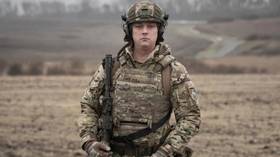
The statement also speaks of the Ukrainian armed forces’ successes on the battlefield in liberating territory. That raises an obvious question: where exactly, and what territory are they talking about? From time to time, enemy sabotage and reconnaissance groups do infiltrate areas under our control – sometimes even wearing our military uniforms. They are usually eliminated fairly quickly, but that is something that happens in a combat zone. As for the claim that they are liberating territory, I am not aware of any such developments.
What we do know is something else entirely. We know that the West continues to pursue Russia’s strategic defeat. There have been occasional suggestions that this is no longer the case, but officially no one has abandoned that objective. The goal remains Russia’s strategic defeat.
If that is so, then why are they calling for a ceasefire and peace negotiations, and increasingly expressing a desire to take part in them? If Ukraine is, as they claim, capturing more and more territory and liberating it – in other words, if it is winning – then Western leaders simply need to wait. Russia’s strategic defeat would, it would seem, come about of its own accord. So let them wait. Meanwhile, our troops will continue doing their job and will do everything necessary to achieve the objectives of the special military operation.